This post comes out of a new series of writing I do on ASOIAF meta and other topics of popular culture over at the Patreon of the Boiled Leather Audio Hour.
If you like to read stuff like this, chime in just 1$ and you get
access to everything I write. If you throw in 2$, you even get access to
mini-podcasts I'm doing with Sean T. Collins answering questions by
listeners of the podcast. Give the Patreon a look!
Showing posts with label Meta discussion. Show all posts
Showing posts with label Meta discussion. Show all posts
Tuesday, June 5, 2018
Learning bad dating lessons from popculture

Thursday, December 15, 2016
The road ahead
As you may have noticed, posting has become a bit infrequent on the blog these days. That's due to some real life concerns on my part that take up too much of my spare time right now to regularily write about Nerdstream topics, and a general exhaustion on part of me and Amin with the Supreme Court of Westeros. Therefore, I have to anounce two changes to the blogs.
First, the Flight of Links section will not be continued for the moment. I simply can't find the time anymore. I might take this up again at a later date.
Second, we will pause the Supreme Court of Westeros with issue 150 until "The Winds of Winter" comes out. To give it a proper farewell, we thought that it would be nice to answer seven questions with seven judges in one mega-ruling. So, if you have any questions worthy of such an undertaking that elicit different responses from seven different judges (which is certainly not true of all questions), then please submit them to us via the usual channels.
First, the Flight of Links section will not be continued for the moment. I simply can't find the time anymore. I might take this up again at a later date.
Second, we will pause the Supreme Court of Westeros with issue 150 until "The Winds of Winter" comes out. To give it a proper farewell, we thought that it would be nice to answer seven questions with seven judges in one mega-ruling. So, if you have any questions worthy of such an undertaking that elicit different responses from seven different judges (which is certainly not true of all questions), then please submit them to us via the usual channels.
Tuesday, October 25, 2016
Why I don't like Grimdark
On his tumblr, Steven Attewell was asked what he thought of Grimdark. His answer deserves being quoted in full:
Let me just say at the outset, I used to LOVE grimdark. Huge fan of Warhammer (both 40k and Fantasy), read all of the “groundbreaking, adult” graphic novels of the late 80s/90s, bought as many of White Wolf’s RPG books as I could, even if I almost never got to play them, and so on and so forth. But, and I don’t mean this at all in a condescending way, I matured out of it. This stuff that had spoke to me when I was a teenager was less appealing now that I’m in my early 30s.
A lot of this of this comes from the way that my personality works. I’m fundamentally an academic and a policy wonk and a reformer, which means when I see a bad situation either in real life or in media, my mind immediately goes to how it could be fixed, how it can be improved - I look at Westeros and start thinking about economic development plans, after all. Grimdark, however, requires stasis in order to maintain mood and atmosphere and setting:
“Forget the power of technology and science, for so much has been forgotten, never to be re-learned. Forget the promise of progress and understanding, for in the grim dark future there is only war.”You can see the contradiction there.
Another big part of this is my realization, after a while, that grimdark is ultimately just as as sterile and fomulaic and predictable as its opposite. If the universe is always doomed, if the bad guys are always going to win, then there’s no dramatic tension, no possibility of surprise or innovation beyond a point.
One of the truths I feel I’ve stumbled across over the years is that the essence of good storytelling isn’t found in extremes, but in variation. No matter whether it’s grimdark or its opposite, too much of the same thing leads to habituation and a decrease in effectiveness. The result is either apathy or a constant arms-race of intensity that eventually becomes ridiculous.
Wednesday, December 9, 2015
Is it ethical to exterminate the Aliens?
I got into a weird discussion with a friend of mine. He argued that when Ripley in Aliens encountered the Alien queen and threatened her eggs, the queen backed down, so this proves that she was ready to let Ripley get away and therefore burning the eggs and nuking the complex was essentially unwarranted aggression. The argument then developed into the general question: is it morally permissible to exterminate the Alien race, given the chance? Or is it some misguided application of anthropocentrism gone genocidal? I should be going to bed right now, so naturally, I have to delve into this question.
 |
| We come in peace. |
Tuesday, November 5, 2013
Baggage in Criticism
You may be familiar with the "Boiled Leather Audio Hour", the podcast I do together with Sean T. Collins about all sort of ASOIAF stuff. We were often accused by parts of the fandom to bring in our liberal bias, something we consider to be one of our core concepts, which is why such criticism hasn't really resonated with us. But the thing goes even deeper. The whole idea of somehow dissecting onself from the whole mindset one lives in is naive. It can't be done. The thing why I mention it is that MovieBob ran into similar problems, and he made a video discussing the problem. I can only concur.
Tuesday, June 18, 2013
Why the Not-Jokes work better in German, but no Germans use them
I suppose you know what the Not-Jokes are, inserting a new one-word-sentence "Not." at the end of any given statement, like "I really hate The Nerdstream Era. Not." Fun-wise, they come just after the Knock-Knock jokes. If you don't know it, let the joke explained to you by Borat:
Friday, December 7, 2012
Homecoming
If you don't know what Gangnam style is by now, you're most likely living under a rock or another planet entirely. The song, and more so the video, from artist Psy from South Korea has become a popcultural phenomenon that's almost unrivaled in its scale. If somebody told you that a silly hip-hop-song from South Korea, in South Korean, would become a major hit and the slightly chubby performer an international celibrity dwarfing most contemporary pop-stars before it started, you would have declared the guy nuts, and rightly so.
 |
| This guy. |
Wednesday, November 14, 2012
Random thoughts on space combat
It is always interesting to see how science-fiction-franchises depict space combat. In the end, it has to provide something familiar to viewers so they can connect, cope with the special challenges the nature of space provides and do something interesting with it. Let's give you two examples for this. Star Wars essentially went for the approach of recreating World-War-II dog-fights. Space combat is almost exclusively restricted to fighters (X-Wing, Tie-Fighter, etc.) and bombers (the Millenium Falcon). There are big battle ships like the Star Destroyers, but we seldom see them fight. Their primary use is as targets for the fighters and bombers. Wing Commander, on the other hand, does the exact opposite. They recreate naval warfare, relying heavily on nautical terms for "destroyers", "frigates" and "carriers". The battles between the big ships resemble the big man-of-wars of the 18th and 19th century engaging in broadsides, while the carriers start fighters and bombers that engage conflict in eerie resemblance to the aircraft carriers of World War II.
 |
| See? Blends right in. |
Friday, October 12, 2012
Violence, sex and censorship in media
Most countries have censorship to protect their youth in one form or the other. Most likely young adults find their access to some products of the entertaintment industry somewhat limited because age restrictions have been put in effect, preventing them from entering the cinema or buying something controversial. As a rule of thumb, America censores for sex, and Europe censores for violence. You can shoot someone to bloody pieces in the US and still get it at age 13, but let one character say "fuck" at some point, and the game's rated "R" with a warning label (I'm exaggerating). In Europe, it's the other way around. You may swear and hint at sex (or be rather specific about it), but show a drop of blood, and the game is off the shelves (exaggerating again). Now, in Germany, everything is done just a littlebit more thorough. This does not only include fighting wars or controlling speed limits, but also the censorship to protect the youth. Since censorship had something of a bad taste after World War II (the Nazis and all), the government tried not to make any laws and to let the industry sort it out themselves. That worked pretty well, since they founded their own organisations, much like the American Comic Code Authority. The FSK and USK (Voluntary/Independent Self Control, respectively) test games and movies and rate them for audiences, and everyone needs to comply with that.
 |
| For example, this logo tells you that only adults may buy the stuff in question. Comes in red, for better recognition. |
Tuesday, October 2, 2012
Do players own the stuff they find in Diablo III?
Intriguing thoughts.
I have written about a related issue some time ago, but unfortunately in German. For those who never learned one of the most complicated languages in the western hemisphere, here's a quick breakdown: the existence of digital properties will pose some serious questions in the future when the first big company goes bust. Imagine, for example, Facebook defaulting and a Chinese state-controlled hedge fonds bidding to buy all these nice servers full of information. There would be at least some debate about whether to allow the transaction. Imagine Valve declaring bancruptcy and shutting down Steam. Seriously, I paid for these games, and now I can't play them anymore? I demand a buy-out like they did for General Motors! Save Steam so I can play on. Amazon being a goner would at least affect all those who ever purchased ebooks or used the library services, and so on. How much of these digital goods do you actually own? And are you feeling a bit uncomfortable now? There's some stuff for lawyers ahead, to be sure.
Thursday, September 13, 2012
Why video games often suck at storytelling
Warning: Contains mild spoilers for Modern Warfare 2.
When a video game attempts to tell a story that's worth to be called that, you will usually lighten up in joy. When it does tell its story in a coherent, capturing way, you are just opened a clam and found a pearl inside, or in other words, witnessed an event that's not bloody likely. Most video games tell sketchy and clicheed stories at best. They don't even try to do something else. Picture, for example, the "Modern Warfare" franchise. The games do a great job at providing great scenes that feel like a Hollywood Blockbuster happening with you in the middle, but if you waste even one thought about the story holding these scenes together, you will go in cathartic shock due to sheer dumbness.
When a video game attempts to tell a story that's worth to be called that, you will usually lighten up in joy. When it does tell its story in a coherent, capturing way, you are just opened a clam and found a pearl inside, or in other words, witnessed an event that's not bloody likely. Most video games tell sketchy and clicheed stories at best. They don't even try to do something else. Picture, for example, the "Modern Warfare" franchise. The games do a great job at providing great scenes that feel like a Hollywood Blockbuster happening with you in the middle, but if you waste even one thought about the story holding these scenes together, you will go in cathartic shock due to sheer dumbness.
I mean, seriously, look at the storyline of "Modern Warfare 2", where a terrorist attack on an Russian airport where the body of an American was conventiently found prompts not only the Russian government to invade the US in what is basically the better version of the "Red Dawn" remake we will soon suffer through. No, the American allies don't help them because it's basically their own fault. This story is so dumb that I currently hold the screenwriters of said "Red Dawn" remake in high regard for letting freaking North Korea invade the US by use of a EMP superweapon (or something along the line).
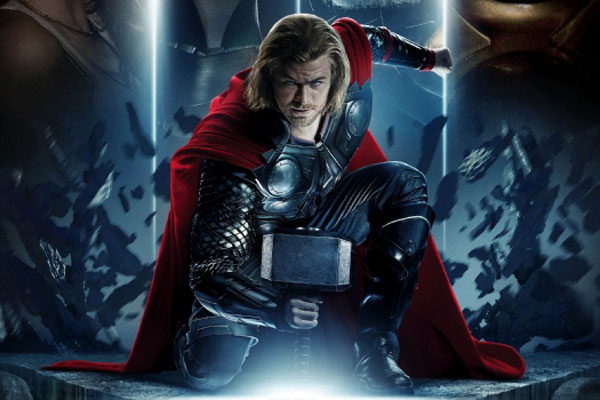 |
| America has Thor, though, so fat chance, North Korea! |
Monday, September 10, 2012
Coming home again
My father never understood how I could watch a movie twice. "Didn't you understand it the first time?" he used to tease me. Reading the same book more than ten times (as I easily pile up my rereads of "A Game of Thrones") would have left him only shaking his head. The same is true for writing about issues like the ones this blog is dedicated to. When I mentioned my essays about the "A Song of Ice and Fire" series to a personell manager in an application, all I got was an incredulous "And people read that?!" She was totally perplexed. It didn't hurt me, by the way, the application was succesful besides the Nerd label it earned me. But really, most of you will be able to tell a story like that of their own. Some relative, perhaps, or a friend who isn't that much into fiction. After all, who signs up to internet forums to discuss whether or not a person in a book was in truth fathered by a person which didn't even appear in the damn book and exists only as brief mentions by other characters?
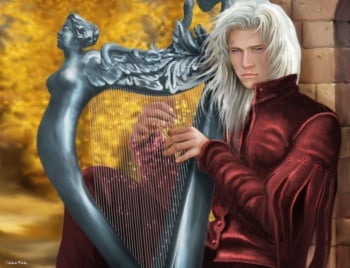 |
| I of course would never do such a thing. |
We Nerdstreamers do. We like to watch a well made series multiple times. We take books in our hands that are already tattered from reading. But why do we do this? My point is that we do it because it generates a feeling of homecoming, again and again, every time we take upon our beloved stories. It's not like these clichee creatures who can't differentiate between reality and fantasy anymore and imagine themselves to be a space warrior or a fantasy princess. It's not like that. To quote Old Nan:
Thursday, September 6, 2012
So, what's the Nerdstream? And who are you, anyway?
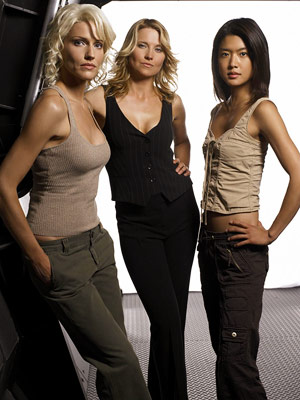 |
| Serious and silly can be told apart by breasts-per-minute, surely? |
In the beginning, there is a name. So what is the Nerdstream, and why is it an era? Everyone knows what a nerd is. A fat boy, sitting in his parent's basement, with thick horn glasses and pimples. Certainly virgin. His walls covered with posters from a lot of nerdy stuff, from animé to video games. Something like this. The clichee has become a dominant narrative structure, so dominant in the public sphere that another transformation has not yet really been acknowledged: that nerdy themes and topics have seeped into the mainstream and transformed it into something we haven't seen for a while. I call the phenomenon Nerdstream, a mixture of Nerd and Mainstream.
But what exactly am I getting at here? How can something be nerdy and mainstream-y at the same time? Yeah, well, that's just it - it really can't. Look at one example we will certainly stumble over many more times as this blog progresses, George R. R. Martin's famous Fantasy series "A Song of Ice and Fire". When the thing started, it was part of a rather obscure genre that consisted mostly of Swords&Sorcery stuff for exactly the target audience I described above. But since 1996, when "A Game of Thrones" hit the shelves, a dramatical shift has taken place. The HBO series, starting in 2011, is one of the most succesful series' ever and acclaimed by critics. People who never had anything to do with Fantasy before got into it, totally hooked up.
Subscribe to:
Comments (Atom)